Monday, June 17, 2013

7. Pride and Prejudice

1995; dir. Simon Langton; starring Jennifer Ehle, Colin Firth
My views: 20

Yes, I know, technically this is a mini-series and not a movie, but I made the executive decision to count mini-series as movies when I was keeping track, and this is too fabulous to be omitted from the blog on a technicality.  This is basically perfection in six 50-minute episodes.  That means I spent 100 of the hours from 2003 to 2012 watching Pride and Prejudice, which might sound excessive to some, but I would gladly devote another 100 hours of my life to it.  By the end of this post, I hope you will have some idea as to why, but the best way to understand is to just go and watch it.

Funnily enough, the first thing I ever knew about Pride and Prejudice was that my dad really liked it.  He and my mom taped it and talked about it a lot, but I didn't get it at all.  I remember trying to watch it with them when I was younger, but always falling asleep in the middle without really knowing what was going on.  I didn't actually sit through the whole thing until 2005, but once I did, I was hooked.  I was enchanted by the story, the character development, and the dialogue.  And before I knew it, this had essentially become my family's theme movie.  We're all completely obsessed with it, and we now own 3 copies on DVD in addition to the video taped copy so that my sister and I could each take a DVD with us to college while still leaving one for everyone else.

I know that Pride and Prejudice is one of the most beloved stories ever written, but I always feel like it belongs to my family and me.  Perhaps other people feel this way as well, and that's part of the reason it's become such a popular story.  Anyway, I've always thought of myself as Jane Bennet, partly because I'm the oldest child and because my given name happens to be Jane, but also because I usually think the best of people and give them the benefit of the doubt.  I'm not quite as good at this as Miss Bennet is, but in my defense, she is a fictional character.  I've also always thought of my sister as Elizabeth Bennet because she's awesome and has definite opinions about people and things, but isn't afraid to admit it when she misjudges them.  The close relationship I share with my sister is also reflected in the conversations between Jane and Lizzy in Pride and Prejudice, although I do think that I'll be the one teaching her 10 children to embroider cushions and play their instruments very ill, but no analogy is perfect.  We named our dogs Mr. Bingley and Mr. Darcy, and Bingley seems to prefer me while Darcy prefers my sister, so that further enforces our perceived roles.  Fitting our brother into the story is a little more difficult, since if the Bennets had a brother a lot of their problems would be solved, but I kind of think of him as Lydia, since he's the youngest and the most lively and outgoing.  However, if we're honest with ourselves, I think we're all more a combination of Mary and Kitty than anything else.  Our parents are thankfully nothing like Mr. and Mrs. Bennet, but they like to pretend they are sometimes, so whenever I'm going anywhere my mom says, "Take every opportunity of enjoying yourself," and whenever anyone mentions lace my dad has to strenuously object.

But it's not just my parents trying to be Mr. and Mrs. Bennet; we all recite this mini-series constantly.  There are so many incredible lines, and they apply remarkably frequently.  I'm pretty sure Mrs. Philips is the character we quote the most, between "Oh, now I understand!" and "Hearts, Mr. Collins, hearts!" but we reference them all a lot.  It's particularly amusing when my dad does his Lady Catherine impression: "She would be in nobody's way in that part of the house."  I think we all really appreciate good dialogue, and even beyond that, all of the actors read their lines with such perfect expression that it's extremely fun to imitate them, particularly the more melodramatic characters.

That's one of the main reasons I prefer this version of Pride and Prejudice to the others that I've seen: the casting is flawless.  Jennifer Ehle is Elizabeth Bennet.  Colin Firth is Mr. Darcy.  Crispin Bonham-Carter is Mr. Bingley, and by far the most likable version of Mr. Bingley I've ever encountered on screen, which I love because the book Mr. Bingley is supposed to be likable, and a lot of times he's portrayed in films as kind of a doofus.  Alison Steadman is Mrs. Bennet.  David Bamber is Mr. Collins.  I could go on, but it's kind of a big cast, and you get the point.  They all adapt the perfect mannerisms and expressions to fit the characters that Jane Austen created.  I'm also a huge fan of the supporting characters.  Most other film versions cut out a lot of the minor characters, often because they don't want to be this long, but I love that this version chooses to leave them in and develop them.  That's part of the reason I can watch it so many times and never get bored: there is so much background character development going on that I missed the first few times I watched it.  I especially like what they did with Mr. Hearst, Maria Lucas, and my personal favorite: Mary's crush on Mr. Collins.  This brings me to the flawless editing, which allows the audience to see the background stories unfold as well as the main stories, and clearly shows us each relevant character's reaction to every important development for just the right amount of time.

Finally, I'm pretty sure that this is the best film adaptation of a book that I've ever seen.  In my experience, when books are adapted to the screen, it is almost always the case that the film comes out lacking.  Often important character development is sacrificed in favor of action scenes, as in the - in my opinion - highly disappointing Harry Potter films.  Occasionally, apart from character names and a vaguely similar plot, the book and the film are barely recognizable as the same story.  I understand that films are different from books, but have always wondered why people who make films based on books can't take the spirit of the original story and transfer it to film.  Granted, I didn't read Pride and Prejudice until after I had seen this, so perhaps my opinion is biased, but I think the people who made this mini-series finally accomplished what I'd always wanted filmmakers to do: stay true to the story without feeling like they couldn't change anything about it.  Many if not most of the lines in this mini-series are direct word-for-word quotes from the book, which is fabulous, but the other lines are all in the spirit of the book, which is even better.  A few scenes were added and changed, but all for a very good reason, and all allowing the characters to remain true to their original counterparts.  The reason for this, of course, is that the filmmakers were very devoted to the original story, which hardly ever happens.  I'm extremely glad it did in this case.

Friday, June 7, 2013

8. The Sure Thing

1985; dir. Rob Reiner; starring John Cusack and Daphne Zuniga
My views: 19

This is another movie my mom had to talk me into watching.  I really had no interest in seeing it, but she got it from the library in 2004 and convinced me to sit through it.  And, like almost all the movies my mom talks me into watching, I fell in love with it.  In 2006 alone I watched it 8 times, I've now seen it a total of 20 times (because I've watched it once this year), and I haven't gotten tired of it yet.  I truly think it's the best teen/young adult movie ever made, and I'm constantly surprised at how few people have even heard of it.

The script is brilliant.  Is it just me, or do all Rob Reiner films have great lines?  From "Get Cowboy Guy a beer" and "I bought some of those hangers you like so much" to "Who invented liquid soap and why?" this movie is full of quotes that I can always use to crack myself up while other people stare at me because for some unfathomable reason, no one has seen this movie.  I guess they don't have moms who talk them into watching it.  Beyond the fantastic script, there's the remarkable chemistry between the two young (at the time) stars.  At first they hate each other as they seem to have nothing in common, but as they get to know each other better they start falling for one another in spite of themselves.  It's a plot that's been done a million times, but very rarely is it done this well.  John Cusack and Daphne Zuniga play off each other wonderfully, and both demonstrate flawless comedic timing, particularly in the scene where they're stranded in the middle of nowhere in the rain with no money trying to break into a deserted trailer, and Daphne Zuniga's character, Alison, suddenly remembers that she has a credit card.  "Credit cards work on a completely different kind of lock!" "I don't think you understand. I have a credit card!" Then her face falls. "Oh. My dad told me specifically that I could only use it in case of an emergency."  And with rain dripping down his whole body, he looks at her with a completely straight face and says, "Well, maybe one will come up."

I also love how the two completely different characters manage to bring out the best in each other, and how he prompts her to become a little more laid back while she prompts him to be a little more self-disciplined, without either of them really trying to change the other.  But honestly, one of my favorite things about this movie, and the reason I think everyone needs to watch it at some point, is because it has a message which I think is far too often overlooked in our society: namely, that having casual sex with as many people as possible is not the be all and end all of human existence.  This is contrary to what many TV shows and movies and books tell us, and certainly contrary to what John Cusack's character, Gib, believes at the beginning of this movie.  After all, it's called The Sure Thing because he's traveling across the country to sleep with a girl he's never met because his best friend from high school promises that she's a sure thing: no questions asked, no strings attached, no guilt involved.  But on his way there, through all of his adventures with Alison, he starts to realize that there's more to life than one-night stands.  The way he goes through this journey, and the way the movie portrays this without shoving any message down our throats, is kind of incredible.  When I talked about Beauty and the Beast I said I liked movies where the characters get to know each other before falling in love, and this film emphasizes the importance of that even more.

I'm not even kidding, if you haven't seen this movie, track it down and watch it immediately, particularly if you are a teenager or college student.  You won't be disappointed.  If you are, you can leave an angry comment, but you won't be.  And stay tuned for my top 7 most-watched movies, all of which I saw at least 20 times from 2003-2012.

Saturday, May 25, 2013

9. Beauty and the Beast

1991; dir. Gary Trousdale, Kirk Wise; starring Paige O'Hara, Robby Benson, Angela Lansbury, Jerry Orbach, David Ogden Stiers
My views: 18

I can't remember not having seen this movie, so I guess for me it really is a tale as old as time.  It's pretty much always been one of my favorite movies, and it's one of only three that I watched at least once every year from 2003-2012 (the other two are numbers 1 and 2 on the list).  In fact, Beauty and the Beast is so near and dear to me that it's quite difficult for me to even know how to begin talking about it.  I know I won't be able to do justice to the effect it's had on me, but I'm going to try.

First of all, I absolutely love the characters.  They're all unique and well-developed and complicated, despite the seemingly simple story they're in.  I've always been particularly fond of the servants-turned-household-objects, like Lumiere, Cogsworth, Mrs. Potts, and Chip.  Obviously, the focus of the story is Belle and the Beast, but the supporting characters are all extremely important.  I find the fact that the servants are still able to put on a happy face, despite the stress they must experience as their hopes of becoming human again have almost completely faded and are suddenly restored if only their master will pull through for them, endlessly fascinating.  I also think Gaston makes a terrifying villain, simply because of how normal he is.  Most of the Disney villains either have evil magical powers, like Maleficent and the Wicked Queen, are over-the-top ridiculous, like Cruella De Vil and Captain Hook, or a combination of the two, like Ursula and Hades.  Gaston is not the brightest person in the world, and yes, he is a bit eccentric, but basically he's just a normal, handsome guy, except for the fact that he's a total jerk.  He's the exact opposite of the Beast, and I think the juxtaposition of their characters is quite well done and interesting.

Then there's the music.  I can't even express how much I love the music of Beauty and the Beast.  Seriously, I'm pretty sure the soundtrack is my all-time favorite album.  The lyrics are at times moving, as in the title song and "Something There", and at times just plain clever.  My personal favorite lyric is "When I was a lad I ate four dozen eggs every morning to help me get large./ And now that I'm grown I eat five dozen eggs, so I'm roughly the size of a barge!"  How do you even come up with something like that?  Howard Ashman was a lyrical genius.  It's one of the great injustices of this world that he didn't live to see this film released, although I think the fact that he was sick while writing these songs makes his feat even more impressive.  And then there's the score, haunting and uplifting and sad all at once.  I still get chills from the opening notes of the Prologue, which I listen to all the time because it's on the soundtrack.  The music in this film is Alan Menken at his best, and I'm pretty sure Alan Menken at his worst is better than most people (see Newsies).  Somehow, every song in Beauty and the Beast is incredibly familiar, yet still new and fresh every time I listen to it.  It's like magic.

I also love the messages in this movie, particularly that looks aren't everything.  Oddly enough, it's the villagers who point this out first, in the opening number when they sing, "She's a beauty, but a funny girl."  Just because someone fits society's idea of beauty does not mean that person will conform to society's ideas of what beautiful people should act like.  I have always looked up to Belle precisely for this reason.  She doesn't care what the villagers say, she's going to keep reading all the time because that's what makes her happy.  Following her example, I've always tried to remain true to myself even when it wasn't popular.  While I know that my peers often ridiculed me for it, like Belle who remains engrossed in her book while the villagers sing about her, I was often too busy to notice.  It's always encouraged me that Belle's refusal to conform really works to everyone's advantage, as she and the Beast end up first bonding over her love of books when he shows her his library.  In the special edition, there's also a really great scene where she starts helping him re-learn to read.  Another thing I love about this is that, unlike in most Disney princess films, the hero and heroine actually get to know each other before they fall in love.  Not that I don't believe in love at first sight, but I don't think everyone who falls in love does so at first sight, so I think it's grossly over-represented in Disney movies.  One could argue that if the prince wasn't disguised as a beast in this story, Belle would have fallen for him at once, but I don't think so.  If that were true, she would have married Gaston, but as she explains to her father, "He's handsome all right, and rude and conceited..."  Belle doesn't like the Beast at first because he acts like the monster he looks like, and it's only when he starts trying to be nice to her that she starts to like him.  I also think it's interesting that the Beast doesn't really fall in love with Belle right away either; it happens gradually until he lets her go.  Love is more than just physical attraction or necessity and it doesn't always happen instantaneously, and I really like the way this movie portrays that.

These are just some of the many reasons why this has always been, and probably will always be, one of my favorite movies.  Of course, I don't think I analyzed it this deeply when I was little, but therein lies the brilliance of good Disney films: thoroughly enjoyable to both children and adults.  It probably helps that I grew up with it, so it's kind of my childhood, but it's also my adolescence and adulthood.  I think everyone needs a movie or two like that.

Wednesday, May 15, 2013

10. It's a Wonderful Life

1946; dir. Frank Capra; starring James Stewart, Donna Reed, Henry Travers, Lionel Barrymore
My views: 16

I think this may have been the very first "old movie" I ever saw - not counting animated films like Pinocchio and Snow White that I had no idea how old they were - because I remember being confused as to why it was in black and white.  My family and I used to watch this on TV pretty much every Christmas, and one year we taped it, so we watched the taped version for a while until we finally got it on DVD.  Now we watch it at least once every Christmas season and often at Thanksgiving as well.

Even though I've watched and loved this movie for most of my life, it's only been in the last 5 years or so that I've really gotten it.  When I was little, I thought it would be cool to have an angel come down and show you how good your life is, but I have to admit that my favorite part was the beginning because I had a huge crush on young George Bailey.  I now have a pretty big crush on Jimmy Stewart, so I guess some things never change.  Anyway, back then, once he grew up, it got kind of boring until Clarence finally came down and showed him what the world would be like without him.  I hate to make the generalization that kids can't fully appreciate this movie until they grow up, but that's what happened to me.  The year I graduated from high school is the year I watched this movie the most.

When you graduate from high school, everybody tells you to follow your dreams and reach for the stars and all that good stuff.  George Bailey had big dreams of travelling the world and becoming a famous architect, but in the whole movie he never leaves Bedford Falls.  He gives up his dreams of college to take over the family business and let his brother play football, he gives up his dreams of independence to marry the woman he loves, and he passes up the opportunity of getting rich to stand up to a scumbag.  Watching this when I was little, I wondered why he couldn't see how much his life was worth, but when I grew up I realized that he has every reason to think his life sucks.  Nothing went the way he planned.  But I bet if he had gone to college and not married Mary and gone to work for Potter, nobody would have shown up at his house to help him out.  I'm not saying we shouldn't have dreams or plans, but it's kind of true that when things don't go as planned, they end up way better than they would have been otherwise.  I also think that too often in our society, we are told to act in our own best interest first.  George spends his whole life doing things for others.  It's not that he never thinks of himself, because he obviously does, but he helps other people first, and that's what saves him in the end.  From the very beginning, Mary sees that and loves him for it, while George compares his lack of money to Potter's abundant wealth and becomes blind to his own worth.  Maybe this sounds sappy to other people, but to me this film gets at real, deep life issues in a way that very few others do.  And that is why, of all the movies I've seen, this is the one that makes me cry the most.  Well, I did cry all the way through Les Miserables, so I guess second most.  Anyway, I've cried at different parts during different viewings of It's a Wonderful Life, but without fail, I always cry during the "Mr. Gower, you put something wrong in those capsules" scene (because even twelve-year-old George helped people, despite getting slapped in the sore ear for his trouble), and when Harry Bailey - the college football star, the war hero, the success of the family by any normal standards -  raises his glass and toasts, "To my big brother George, the richest man in town."

I think it's interesting that this film is tied with Ishtar (I put this one higher since I know I saw it multiple times before 2003) because Ishtar always makes me think of my mom and It's a Wonderful Life always makes me think of my dad.  For as long as I can remember I've thought of this as my dad's favorite movie.  He was always the family member who was the most excited to watch it at Christmastime and quoted it the most enthusiastically.  Even more than that, though, I've always thought of my dad as being kind of like George Bailey.  It doesn't hurt that they're both deaf in their left ear, but I think there are a lot of deeper similarities as well.  My dad usually puts other people's interests over his own, and in so doing often doesn't realize the tremendous impact he has.  But when he was in the hospital a year ago, the people in his life showed such an outpouring of love and support that it really reminded me of the scene at the end of It's a Wonderful Life when the whole town comes to help George.

I could go on and on forever about this movie, but I'll stop now because this post has already gotten plenty long.  I will warn you, though, that now that we've gotten into the top 10, I'm going to have a lot to say about these films because they've all had a tremendous impact on my life.  Conciseness has never been my strong suit, particularly in topics I'm passionate about.  So be prepared for some long and I hope not too boring posts.

Saturday, May 11, 2013

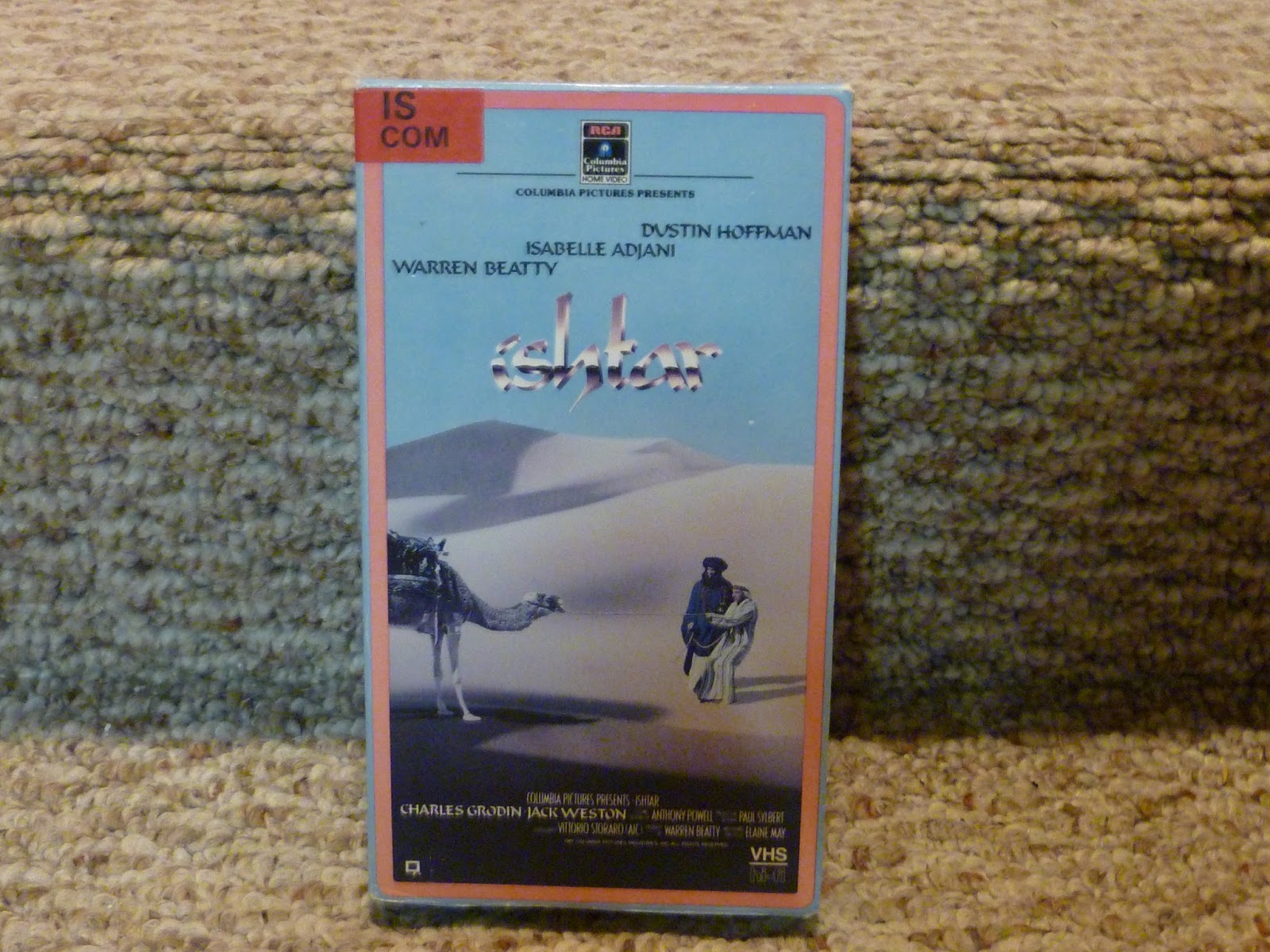
11. Ishtar

1987; dir. Elaine May; starring Warren Beatty, Dustin Hoffman, Isabelle Adjani, Charles Grodin
My views: 16

This inspirational film about two aspiring songwriters, Lyle Rogers and Chuck Clarke, who pursue their dreams despite many obstacles, the most glaring of which being their complete lack of talent, is often - unfairly, in my opinion - cited as one of the worst films ever made.  I'm sure that many serious film buffs would be very upset to know that a blogger who calls herself bestpicturewatcher has seen Ishtar 16 times.  If there are any still reading this after Ella Enchanted made the list I don't know what to say to them, except that as far as I can see, there are only two reasons people could hate this film: they don't understand it or they've never seen it.

I'm pretty sure I'd heard my mom talk about this movie before, but we didn't get it from the library until May of 2006.  I remember sitting down to watch it with my parents and my dad telling me that he thought it would probably become one of my favorite movies because my mom loved it so much.  That was when I found out that my dad could predict the future.  I ended up watching it three times in that month alone, the following month we bought it for $3 from the video store that was getting rid of its video tapes, and by the end of the year I'd seen it a total of 8 times.  I'm pretty sure it's still the most entertaining film I've ever seen in my life.  The songs are so hilariously bad that they're good, and it became my greatest ambition to own the soundtrack, until I found out that, despite what the credits say, one was never released.  Still, my friend found a few of the songs and song clips on the internet and burned them onto a CD for me, so I've gotten as close to owning the soundtrack as possible, and I kind of listen to it all the time.  "Tellin' the truth can be dangerous business: honest and popular don't go hand-in-hand.  If you admit that you can play the accordion, no one will hire you in a rock-and-roll band!"

While the songs are definitely my favorite aspect of the film, they are by no means the only thing I love about it.  The songwriters get a booking in Morocco, where they are caught up in all kinds of political conflict, torn between Isabelle Adjani and Charles Grodin, who do not get enough credit for their ability to keep straight faces in this movie.  But Rogers and Clarke have about as much political know-how as songwriting talent, and they have no idea what's going on, which only adds to the hilarity.  I know that this movie had a huge budget and doesn't really look like a big-budget film, but between the songs, the performances, and the brilliant script, it's priceless.  Seriously, some of my favorite quotes are in this movie, from "You say you'd rather have nothing than settle for less" to "The dome of the Emir's palace in Ishtar is gold, and the people have never seen a refrigerator."  Tell me this isn't brilliant.

I think the main reason I've seen Ishtar so many times is it's like they combined my mom's and my sense of humor and made it into a movie.  I know I've been talking about my mom a lot on this blog, but of all the movies we've watched together I really consider Ishtar to be "our movie".  Sometimes my dad watches it with us, and I've shown it to at least one of my friends, but I don't think either of my siblings has ever seen the whole thing.  This is what my mom and I usually pick when we're alone and feel like watching a movie together.  I don't think either of us would call it our favorite movie, and certainly not the best movie ever made, and there are definitely things about it we don't like, but it just clicks with us.  We use it as a reminder not to take life or ourselves too seriously.  So now, as Mother's Day approaches, I would like to take this opportunity to thank my mom for giving me her sense of humor and love of movies.  I don't care if other people hate it: to me, Ishtar will always be something special that my mom and I share.

Monday, May 6, 2013

12. The Bachelor and the Bobby-Soxer

1947; dir. Irving Reis; starring Cary Grant, Myrna Loy, Shirley Temple
My views: 14

I feel like for some reason the rest of my family watched this without me before I'd seen it.  I can't remember if I had to do something else or I just didn't feel like watching a movie or what, but I think it's interesting to note that this is yet another film I was initially hesitant to watch that became one of my favorites.  But once I did see it, I loved it.  I think the first time I saw it must have been 2002 because I remember being really obsessed with it in 7th grade (which would have been the 2002-2003 school year).  I was particularly fond of the "you remind me of a man" routine (You remind me of a man. What man? The man with the power. What power? The power of hoodoo. Hoodoo? You do. Do what? Remind me of a man. What man? etc), which I taught to anyone who would listen and recited ad nauseum. I remember one day my best friend and I kept it going all the way through lunch, much to the annoyance of the people sitting around us.  We were in a writing class together that year and one of the assignments was to write a play with a partner, and our play included the "remind me of a man thing".  Like I said, I was obsessed.

Of course, this film has a lot more to recommend it than one clever comedy routine.  I mean, for one thing, it has Cary Grant, in all his ridiculously attractive, talented glory.  And Myrna Loy is, as always, simply marvelous.  I can't believe she didn't make it into more films on this blog because I love her sophisticated wit, and I particularly enjoy seeing her and Cary Grant play off each other (I watched Mr. Blandings Builds His Dream House 9 times in those 10 years).  With Cary Grant and Myrna Loy together, you can't go wrong.  But I actually think one of the best aspects of this movie is getting to see Shirley Temple all grown up.

My grandma, who doesn't particularly like movies in general, loves Shirley Temple, and I remember watching films like Bright Eyes and The Little Princess at my grandparents' house when I was little.  This was probably her last good film, and she retired from movies soon after.  It makes me sad that filmmakers couldn't figure out what to do with her when she was no longer a cute little child because I'm pretty sure this is my favorite Shirley Temple movie.  She is so perfect in this role, and I wouldn't want to watch it with anyone else as Susan Turner.  I think it's interesting that in this, like many if not most of her earlier films, she again plays an orphan, since she was always good at eliciting sympathy from the audience in such roles.  But the way she fawns over Cary Grant's character is what really makes this movie stand out for me.  She is the perfect embodiment of a fangirl, living out every fangirl's dream: namely, being ordered by the court to date the object of your affections.  The moment this movie became one of my absolute favorites was the moment I realized that I kind of was Shirley Temple's character: in love with Cary Grant despite our age difference, which, considering that Shirley Temple is old enough to be my grandmother and he's too old for her, is quite significant.  This was the first time I had ever related to Shirley Temple, since straight-haired, completely uncoordinated child me never saw anything of myself in the curly-topped dancing wonder on my grandparents' screen.  Whenever I watch this, for an hour and a half, I can live vicariously through her, pretending it's me who gets to fawn over Cary Grant in shining armor.

But that's only part of the story.  Shirley Temple's character learns that just because you find someone attractive doesn't mean you're going to end up together, nor should you, particularly if he's much better suited to your older sister.  There is nothing inherently wrong with her crush on the attractive older artist, until she starts taking it too seriously, which is when everything falls apart.  So I think this film serves as a good reminder to people who are harboring celebrity crushes not to let their fantasies get in the way of real life.  I, of course, always follow this advice.  Well, usually.  Sometimes.

Friday, May 3, 2013

13. The Major and the Minor

1942; dir. Billy Wilder; starring Ginger Rogers and Ray Milland
My views: 13

This was one of the first "old movies" my mom got from the library to watch with me, and is one of the major reasons why I fell in love with them (pun slightly intended).  It was also the first film I wrote down in 2003 (although I'd seen it before then, and I also probably saw a few movies earlier in 2003 and forgot to write them down), so in a way it's the movie that's most responsible for this blog.  It's also one of the main reasons I'm such a huge Ginger Rogers fan.  So The Major and the Minor is kind of a big deal to me.

It was the second Ginger Rogers movie I ever saw.  The first was the 1965 TV version of Rodgers and Hammerstein's Cinderella, which my grandparents had on VHS and I watched throughout my childhood.  I remember one viewing in particular when we got to the part when Cinderella and the prince are off dancing together, and the king turns to the queen and says, "May I have this dance, Your Majesty?" and she replies, "I was wondering when you were ever going to ask me, Your Majesty!"  As they stepped out onto the dance floor this particular time, my mom turned to me and said, "They put that in there to be funny because that actress was a famous dancer."  I have no idea why this stuck with me because at the time I had no clue who Ginger Rogers was or that she would one day become one of my all-time favorite actresses.  Anyway, I kind of like that my first introductions to her were outside the context of Fred Astaire's dance partner because, while she did that indescribably well, she was so much more than that.  The Major and the Minor in particular, in addition to Monkey Business and Stage Door, helps demonstrate her incredible comedic talent.  I've read reviews saying she was miscast in this movie because she doesn't look 12 at all.  I would agree with those people if she was playing a 12-year-old, but she's not: she's playing a 30-year-old character who's kind of failing at pretending to be 12.  Then later in the film, she's playing a 30-year-old pretending to be the 40-year-old mother of the 12-year-old she was pretending to be earlier.  In my opinion, she pulls all this off flawlessly.  The audience is never supposed to think she's 12, and they're supposed to think it's ridiculous that other people believe that she is.  And, like I said in my Monkey Business post, Ginger Rogers is hilarious at playing a grown up child, so if nothing else it would be fun to watch from that standpoint alone.  But it's more than that.  In Monkey Business she plays a character who, at given times, truly thinks she is a child.  In The Major and the Minor, her character's always perfectly conscious of how ridiculous her situation is, and that is conveyed to the audience through subtle facial expressions and mannerisms that are missed by the other characters.  The two main things I love about this film are: first, it was one of the first to show me how awesome movies from the 1940's were; and second, it gives Ginger Rogers a chance to demonstrate her acting talents in a way that few of her roles permitted.

Yes, on the surface, it's a totally ridiculous story.  A woman can't afford her train ticket home so she disguises herself as a 12-year-old so she can pay half fare, and ends up running into a military academy instructor and having to go with him to prove to his fiancĂ©e that she's a little kid and not some woman he's having an affair with.  Confused yet?  Anyway, in the hands of a lesser director, it might have been a silly, semi-entertaining yet forgettable film.  But this is Billy Wilder we're talking about.  He knew what he was doing.  Like most good comedies there's deeper meaning behind the silliness.  To me, especially watching when I was 12, it's always been kind of sad to see how out of touch with childhood adults can become.  Susan Applegate has no idea how to act like a 12-year-old, but it doesn't matter because most of the other adults she comes across don't question it.  The only person who figures it out is an actual 12-year-old girl, who quips, "You're not 12 just because you're acting like 6."  I know that this is an extreme example, and in reality this sort of thing probably wouldn't happen, but there's an element of truth behind this exaggeration.  Adults can forget what it was like to be a kid.  From the first time I saw this movie, I vowed I wouldn't let that happen to me.